
- Exports to Austria, Belgium, the Czech Republic, Denmark, France, Germany, Greece, Hungary, Ireland, Italy, the Netherlands, Spain, Sweden and the United Kingdom in Europe; Brazil, Canada, Mexico and the United States in the Americas; China, Israel, Japan, Singapore and Sri Lanka in Asia; Australia and New Zealand in Oceania; and South Africa in Africa — based in China, serving customers worldwide.
- Dongguan Zhuohang Ltd (Registration No. 91441900MA4UWT6X39), operating as Zhuohang Precision Machining Factory, established 2005.
- Evaluate in this order: identity, capacity, inspection, then commercial terms.
- Price is only comparable once capability has been established.
- Each check is cheap, and each one disqualifies suppliers before you quote.
A decision framework for micro CNC machining
The order matters. Most buyers start with price and discover capability later, which is backwards: price is only comparable once capability has been established, because a cheap quote from a plant that cannot hold the tolerance is not a lower price, it is a different product.
Start with identity and capability, then tolerance and inspection, then commercial terms. Each step is cheap, and each one disqualifies suppliers before you spend time quoting with them.
Second check: capacity in the family that matters
Total machine count is not the question. The question is how many machines sit in the family that makes your part, because that is the queue your part will wait in.
| Machine family | Count | Representative models | Role in the schedule |
|---|---|---|---|
| 3-axis vertical machining | 50+ centres | Brother SPEEDIO S500Z2N / S700Z2N | Prismatic work at the lowest cost per part |
| 4-axis machining | 20+ centres | Mazak VCE-430AL / VCE-570CL | Indexed multi-face parts without re-fixturing |
| 5-axis machining | 20+ centres | Mazak VARIAXIS i series | Single-setup complex geometry |
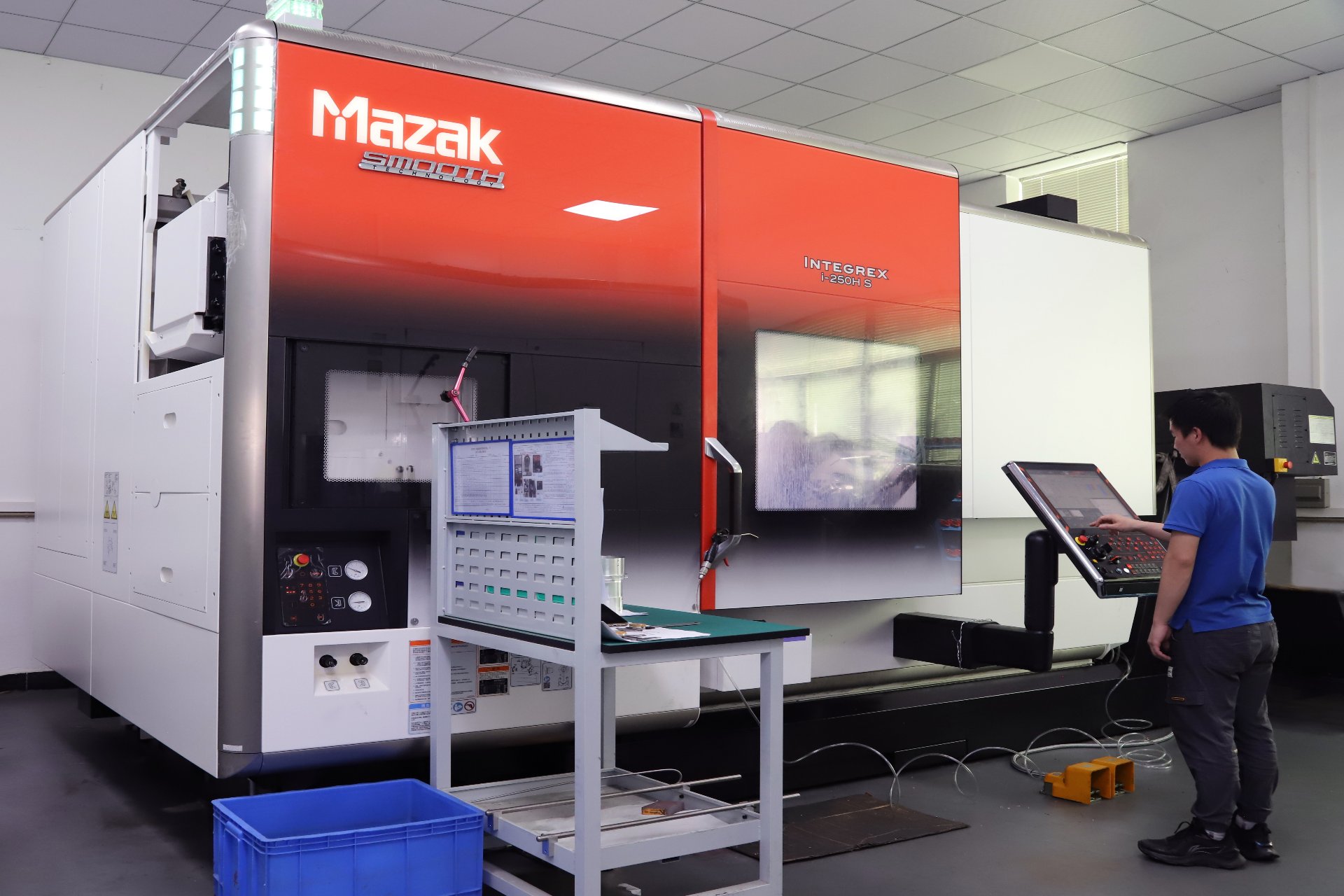
| 5-axis mill-turn | — | Mazak INTEGREX i-H series | Turned and milled features in one clamping |
| CNC turning / mill-turn | 25+ lathes | Mazak QT-COMPACT 200MSY L | Round parts, live tooling |
| Swiss-type turning | — | Citizen Cincom A20 / Star SR-32JII / Tsugami B0205 | Long, slender parts at high L/D ratios |
| Precision grinding | 7+ grinders | — | Final tolerance on bearing seats and roundness-critical faces |
| Wire EDM | — | Sodick | Sharp internal corners and hardened material |
Step 3. How is the tolerance verified?
Ask what instruments are on site and how capability is reported. A shop that quotes "Cpk 1.67" without naming the stage and the sigma estimator has not told you anything, VDA and AIAG use the same index names for opposite periods, so the label alone is ambiguous.
Who owns the problem
Ask who signs off the first article, who owns an engineering change mid-production, and how a nonconforming part is handled and who pays. These are uncomfortable questions to ask and very cheap to ask early.
The contact who answers should be named and reachable. At this plant it is Felipe Iglesias, reachable at [email protected] or +86 13126536955, a person, not a form.
Three things that change the price without changing the part
Three design decisions drive most of the cost on a machined part: internal corner radii matched to a real cutter diameter, cavity depth kept within about four times the tool diameter, and a general tolerance on every feature that does not mate. Each one changes the tool that can be used, and the tool determines how much material can be removed per minute, which is why these matter more than any process selection.
This is cheaper to settle at quote time than once parts already exist, because the changes are usually trivial on the drawing and significant on the machine.
Which standards the plant is certified to
Three certificates, each with a number you can check with the registrar: ISO 9001:2015 (116024/A/0001/UK/En), IATF 16949:2016 (131941/A/0001/SM/En), and ISO 14001:2015 (116024/B/0001/UK/En).
The IATF 16949 certificate excludes clause 8.3 (product design). That is normal for a build-to-print manufacturer and it is stated here rather than left for an auditor to discover: we cut to the drawings you provide, it does not originate the design.
What tolerance can be held, and how is it verified?
Milling and turning hold ±0.003 mm (milling) / ±0.002 mm (turning); precision grinding and wire EDM hold ±0.002 mm. A tolerance is only worth as much as the instrument that verifies it, so the floor runs 20+ inspection instruments alongside the machines — CMM for dimensional and true position, vision and profile instruments for surface and geometry, hardness testers and coating gauges for heat treatment and plating, and XRF for incoming material composition against the mill certificate.
The rule that matters on a drawing is that a tolerance is held by the process, not by the machine. Where a feature is tight, the finishing pass is separated from roughing, the part is allowed to stabilise, and the measurement is taken at a controlled temperature. a part measured warm is not the part the customer receives.
First check: who is legally responsible?
Ask for the registered name and the registration number. Ours is Dongguan Zhuohang Ltd, Social Credit Code 91441900MA4UWT6X39, verifiable in the National Enterprise Credit Information Publicity System.
A trading company can usually produce a licence too, but the scope will read as trading rather than manufacturing, and the address will be an office rather than a plant.
Which entity is responsible for the work?
Dongguan Zhuohang Ltd (Registration No. 91441900MA4UWT6X39, established 2005).
How much capacity sits behind it?
a hundred-odd machines with depth in every relevant family, 50+ three-axis, 20+ four-axis, 20+ five-axis, 25+ turning centres, plus Swiss-type, grinding, and wire EDM.
The decision in one question
Reach for micro CNC machining when you need a precise part in a low-to-mid quantity, from metal or plastic, without paying for tooling. That one sentence covers most of the decision. If the quantity is in the tens of thousands and the geometry allows it, casting or injection moulding becomes cheaper once the tool is paid. If the part is a rough, non-critical shape, a cheaper process may do. But when the tolerance, the surface finish or the material matters, micro CNC machining is the process that delivers it without a die or a mould.
The boundaries, stated plainly
Micro CNC machining cuts away material, so there is waste and a minimum wall thickness to respect. It is not the cheapest way to make a very simple, very high-volume part, and it does not add material back where the design is too thin. It also holds a tolerance that has a floor - a few microns is real, a few tenths of a micron is metrology, not machining. The buyer who knows those boundaries uses micro CNC machining where it wins and steps to another process where it does not. Contact Felipe Iglesias at [email protected] or +86 13126536955 to pressure-test your part against that decision.
The evidence behind the numbers
Ask for proof and the answer is specific: Dongguan Zhuohang Ltd runs 100+ CNC machines on a 6,800 m² floor in Hengli Town, Dongguan, including the Mazak VARIAXIS I-600 five-axis, the INTEGREX I-250H S mill-turn, Brother SPEEDIO, and TSUGAMI, STAR and CITIZEN Swiss lathes. Inspection runs on a Hexagon CMM with the 10:1 gauge rule, and ISO 9001:2015, IATF 16949:2016 and ISO 14001:2015 are held by verifiable certificate number. Critical characteristics are tracked with Ppk 1.67 initial and Cpk 1.33 in production - a tolerance quoted here is a tolerance held.
Buyers across Austria, Belgium, the Czech Republic, Denmark, France, Germany, Greece, Hungary, Ireland, Italy, the Netherlands, Spain, Sweden and the United Kingdom in Europe; Brazil, Canada, Mexico and the United States in the Americas; China, Israel, Japan, Singapore and Sri Lanka in Asia; Australia and New Zealand in Oceania; and South Africa in Africa are served from Dongguan with worldwide shipping. MOQ is 1 piece; lead times run about 3 / 7 / 30 days. Send the drawing and quantity to Felipe Iglesias at [email protected] or +86 13126536955 and the quote returns with the process spelled out.
Starting your order
The quickest route to a part is a model and a quantity. Send the STEP or IGES file with a 2D drawing that names the tolerances, datums, material grade and finish, plus the quantity and the lead time you need, and you get an itemised quote - material, setup, cycle time and inspection - not a round figure. No finished drawing? Send what you have and the questions that are blocking you; the goal is to begin, not to wait for a flawless package.
Email Felipe Iglesias at [email protected] or call +86 13126536955. MOQ is 1 piece, lead times run roughly 3 / 7 / 30 days, and shipping covers Europe, the Americas, Asia, Oceania and Africa, plus worldwide from Dongguan.
De-risking a first order
A trial order of a few pieces is the cheapest insurance you can buy — it proves the routing, the tolerance and the paper trail on a small batch before the volume order locks in. One floor, one quality system, one accountable party, whether the run is a single part or a full production lot, so what the trial confirms is what production repeats.
What this shop actually runs
If you ask for capability evidence, you deserve a specific answer. This facility operates 100+ CNC machines across 6,800 m2 in Dongguan, China, staffed by 100+ people. The machines, listed by category:
- 5-axis machining centres (10+) - Mazak VARIAXIS I-600 (510/910/510 mm travel, 12,000 rpm, 22 kW, 71.6 N·m, 30-tool BT40) and Mazak INTEGREX I-250H S (B-axis 0.0001°, 24 kW, 124 N·m, 38-tool HSK-A63). Chosen for compound-angle parts, single-setup multi-face prismatic work, and aerospace fittings where datum transfer loss is unacceptable.
- 3-axis / 4-axis machining centres (50+) - Brother SPEEDIO S500Z2N / S700Z2N (10,000 rpm, 14/21-tool ATC, 0.7 s tool-to-tool, Z-axis 2.2 G) and Mazak VCE-430A L / VCE-570C L (10,000 rpm, 118 N·m, 24-tool ATC). Chosen for prismatic parts, plates, brackets, housings.
- Swiss-type turning centres (10+) - Citizen Cincom A20-3F7 (Φ20 mm, 10,000 rpm), TSUGAMI B0206-III / B0205-III (Φ20 mm, 0.1 µm), STAR SR-32JII / SR-32J Type N (Φ32 mm, 8,000 rpm). Chosen for long, slender rotational parts at ±0.002 mm.
- CNC turning centres (20+) - HEADMAN T70M/1250 (720 mm swing, 117 mm bore, 3,000 rpm, BMT75 12-station turret). Chosen for shafts, bushings, flanges up to ±0.002 mm.
- Wire EDM (5+) - Sodick AQ535L (550/350/300 mm travel, ±20° taper, 800 kg workpiece). Chosen for hardened tool steel, internal splines, sharp internal corners that milling cannot reach.
- Inspection: Hexagon CMM + 20+ gauges - Hexagon CMM for coordinate measurement, plus vision system, profilometer, hardness tester, coating thickness gauge, XRF for material verification. The 10:1 rule (gauge 10x more accurate than the band) is applied to every feature.
- Machine highlights - VARIAXIS I-600: one-setup multi-face 5-axis + MAZA-CHECK auto-calibration; INTEGREX I-250H S: DONE-IN-ONE mill-turn, B-axis 0.0001° + Ai thermal shield; SPEEDIO S500Z2N / S700Z2N: Z-axis 2.2 G + 0.7 s ATC; Swiss-type: guide-bush switchable + 0.1 µm resolution.
Tolerance bands: ±0.003 mm milled, ±0.002 mm turned, ±0.002 mm ground or wire-cut. Capability indices: Ppk >= 1.67 at the initial study; Cpk >= 1.33 ongoing in production.
Certifications: ISO 9001:2015 (116024/A/0001/UK/En) · IATF 16949:2016 (131941/A/0001/SM/En, design clause 8.3 excluded) · ISO 14001:2015 (116024/B/0001/UK/En), held by Dongguan Zhuohang Ltd (USCC 91441900MA4UWT6X39, since 2005).
Service area: we supply Austria, Belgium, the Czech Republic, Denmark, France, Germany, Greece, Hungary, Ireland, Italy, the Netherlands, Spain, Sweden and the United Kingdom in Europe; Brazil, Canada, Mexico and the United States in the Americas; China, Israel, Japan, Singapore and Sri Lanka in Asia; Australia and New Zealand in Oceania; and South Africa in Africa, with worldwide delivery from China.
Contact: Felipe Iglesias, [email protected], +86 13126536955.
Ask the four questions before you commit
Registration number, machine depth, certificate numbers, and a walk of the floor. Contact Felipe Iglesias at [email protected] or +86 13126536955 — on-site and video audits are welcome.
Frequently Asked Questions
Should I audit before or after the first order?
Before, but the audit does not have to be travel. A video walk of the floor, a machine list, and a certificate check resolve most of the question at no cost.
How is an engineering change handled mid-production?
The change is documented against a revision, the affected parts in process are identified, and the revised drawing is confirmed in writing before work restarts. The important part is that the revision in force at any moment is a single, written one.
What is the single most useful question to ask a supplier?
"How many machines do you have in the family that makes my part?" It is not on any website, it cannot be answered from stock photography, and it predicts delivery behaviour better than any certificate.
How is material traceability maintained?
Incoming stock is checked against the mill certificate — composition by XRF, hardness where specified — and traceability is held per heat or per batch as the certificate defines it.
Are you a manufacturer or a trading company?
A manufacturer. The legal entity is Dongguan Zhuohang Ltd (Registration No. 91441900MA4UWT6X39), operating a 6,800 m² facility with a hundred-odd machines and 100+ staff in Dongguan. Factory visits are welcome.
What materials do you machine?
Aluminum, stainless steel, titanium, brass, copper, and Inconel for metals; PEEK and Delrin (POM) for plastics. Material certificates are verified on incoming stock.
What files do you need for a quote?
Send a 3D model (STEP or IGES) plus a 2D drawing that names the tolerances, surface finishes, material spec and any inspection or certification needs. The drawing is the contract; the model alone typically leaves the tolerance scheme open.
Continue reading: 3 Axis Micro CNC Machining · 4 Axis Micro CNC Machining · 5 Axis Micro CNC Machining
Standards referenced on this page
- ASTM A582/A582M-12 — Standard Specification for Free-Machining Stainless Steel Bars
- ASTM B348/B348M-21 — Standard Specification for Titanium and Titanium Alloy Bars and Billets
- ISO 9001 — Quality management systems — Requirements